Real patients being treated with DUPIXENT. Individual results may vary.
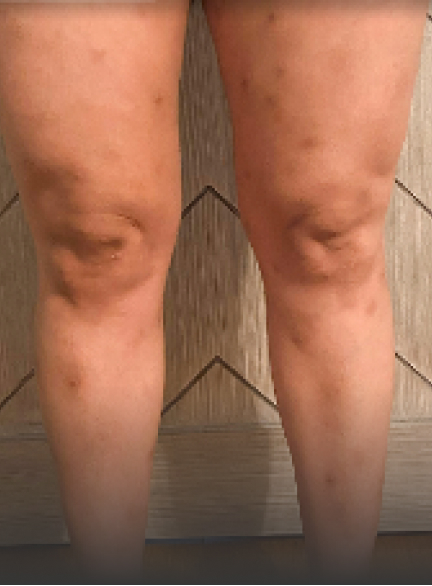
39 years old
“Doctors had no knowledge of what was causing my skin condition.”
—Jennifer
Struggled to get a proper diagnosis
- Went to the doctor when she first saw red dots on her thighs
- She tried over-the-counter and topical Rx options, but the signs and symptoms continued to get worse
- Jennifer saw different doctors who ran tests that were inconclusive
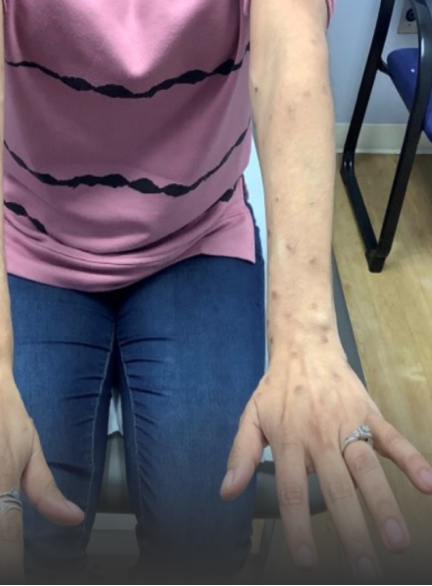
39 years old
“I felt extremely itchy, and the nodules were always there. I tried topicals and even steroid injections.”
—Jennifer
Tried many treatments for ever-present nodules and constant itching
- Red dots on her thighs eventually progressed to nodules all over her legs and arms
- The itching was persistent and extremely uncomfortable
- Steroids provided only short-term relief, whether topical, oral, or injected into the nodules

42 years old
“With DUPIXENT, I have it under control.”
—Jennifer
After a long journey, a treatment worked
- After years of bleeding and nodules, Jennifer saw a dermatologist who diagnosed her with PN
- Then, DUPIXENT was approved for PN and she was finally able to gain control of her disease
39 years old
“Doctors had no knowledge of what was causing my skin condition.”
—Jennifer
Struggled to get a proper diagnosis
- Went to the doctor when she first saw red dots on her thighs
- She tried over-the-counter and topical Rx options, but the signs and symptoms continued to get worse
- Jennifer saw different doctors who ran tests that were inconclusive
39 years old
“I felt extremely itchy, and the nodules were always there. I tried topicals and even steroid injections.”
—Jennifer
Tried many treatments for ever-present nodules and constant itching
- Red dots on her thighs eventually progressed to nodules all over her legs and arms
- The itching was persistent and extremely uncomfortable
- Steroids provided only short-term relief, whether topical, oral, or injected into the nodules
42 years old
“With DUPIXENT, I have it under control.”
—Jennifer
After a long journey, a treatment worked
- After years of bleeding and nodules, Jennifer saw a dermatologist who diagnosed her with PN
- Then, DUPIXENT was approved for PN and she was finally able to gain control of her disease
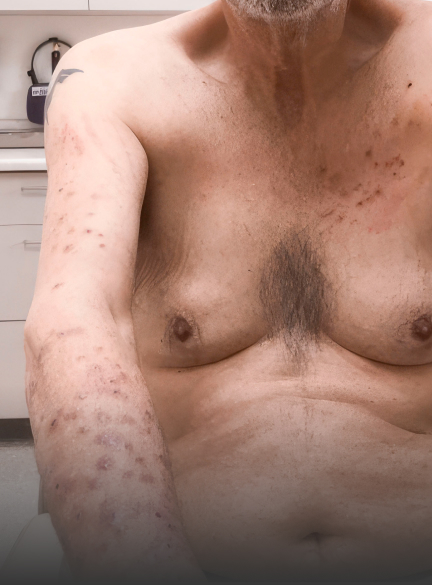
70 years old
“Other people don’t understand that it’s an itch you can’t scratch away.”
—Roger
The condition was initially a mystery
- It began as an itch with spots and discoloration
- Roger was surprised when he started getting itchy with nodules on his legs
- After a few months, he saw a dermatologist and was diagnosed with PN
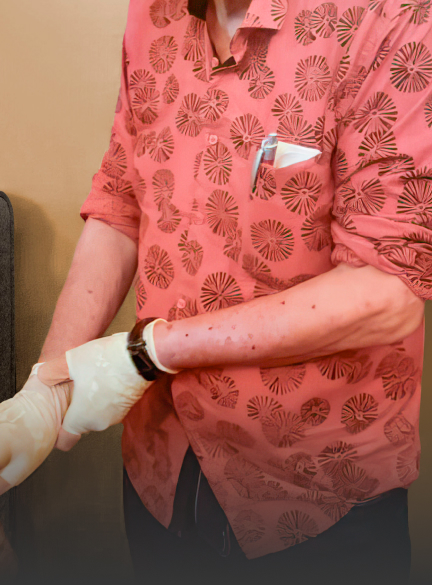
70 years old
“As a professional guitar player, I wore latex gloves because the nodules on my hands were so prominent.”
—Roger
Nodules increased in number and appeared in hard-to-cover areas
- The nodules were unsightly; as a musician, Roger did whatever he could to cover them up during performances
- Tried homeopathic and over-the-counter anti-itch creams and even phototherapy
- Was prescribed various oral and topical corticosteroids, but the nodules and itching remained

74 years old
“The good thing with DUPIXENT is that I itch less.”
—Roger
Finally Roger found help
- Together, Roger and his dermatologist decided to start DUPIXENT
- After starting DUPIXENT, Roger’s itching was significantly improved
- His nodules have since flattened and are barely noticeable; currently, no new nodules have appeared
70 years old
“Other people don’t understand that it’s an itch you can’t scratch away.”
—Roger
The condition was initially a mystery
- It began as an itch with spots and discoloration
- Roger was surprised when he started getting itchy with nodules on his legs
- After a few months, he saw a dermatologist and was diagnosed with PN
70 years old
“As a professional guitar player, I wore latex gloves because the nodules on my hands were so prominent.”
—Roger
Nodules increased in number and appeared in hard-to-cover areas
- The nodules were unsightly; as a musician, Roger did whatever he could to cover them up during performances
- Tried homeopathic and over-the-counter anti-itch creams and even phototherapy
- Was prescribed various oral and topical corticosteroids, but the nodules and itching remained
74 years old
“The good thing with DUPIXENT is that I itch less.”
—Roger
Finally Roger found help
- Together, Roger and his dermatologist decided to start DUPIXENT
- After starting DUPIXENT, Roger’s itching was significantly improved
- His nodules have since flattened and are barely noticeable; currently, no new nodules have appeared
Clinical Trial Designs and Results
Trial Designs: A total of 311 adults in PRIME and PRIME2 with prurigo nodularis were randomized to DUPIXENT or placebo. All DUPIXENT-treated participants received 300 mg Q2W after a 600 mg loading dose. At baseline, participants had an average WI-NRS score of ≥7 (on a scale of 0 to 10) and ≥20 prurigo nodularis lesions in total at screening visit and Day 1 (inclusion criteria). In addition, ≈60% of participants were on a background therapy of TCS/TCI, and 43% had a history of atopy (defined as having a medical history of atopic dermatitis, allergic rhinitis/rhinoconjunctivitis, asthma, or food allergy). No participants had moderate-to-severe atopic dermatitis at study entry or at any time 6 months prior to study entry (exclusion criteria).1,2
Trial Results: The primary endpoint was the proportion of participants with improvement in WI-NRS by ≥4 points from baseline at Week 24 (60% of participants treated with DUPIXENT vs 18% with placebo in PRIME, P<0.001) and Week 12 (37% of participants treated with DUPIXENT vs 22% with placebo in PRIME2, P=0.022). Other endpoints included the proportion of participants with IGA PN-S 0 or 1 at Week 24 (the equivalent of 0 to 5 nodules; 48% of participants treated with DUPIXENT vs 18% with placebo in PRIME, P<0.001; 45% of participants treated with DUPIXENT vs 16% with placebo in PRIME2, P<0.001) and the proportion of participants who achieved both ≥4-point improvement in WI-NRS and IGA PN-S 0 or 1 at Week 24 (39% of participants treated with DUPIXENT vs 9% with placebo in PRIME, P<0.001; 32% of participants treated with DUPIXENT vs 9% with placebo in PRIME2, P<0.001).1,2

a The worldwide patient number is largely comprised of patients treated with DUPIXENT from 11 countries (Brazil, Canada, China, France, Germany, Italy, Japan, the Netherlands, Spain, UK, and US) and the rest of the world comprising ≈12% of this worldwide patient number. This number is composed of the following US approved indications: AD, AFRS, asthma, BP, COPD, CRSwNP, CSU, PN, and EoE. Data through March 2026.
Watch healthcare providers discuss the impact of DUPIXENT on their patients
AD, atopic dermatitis; AFRS, allergic fungal rhinosinusitis; BP, bullous pemphigoid; COPD, chronic obstructive pulmonary disease; CRSwNP, chronic rhinosinusitis with nasal polyps; CSU, chronic spontaneous urticaria; EoE, eosinophilic esophagitis; IGA PN-S, Investigator’s Global Assessment PN-Stage; PN, prurigo nodularis; Q2W, once every 2 weeks; TCI, topical calcineurin inhibitors; TCS, topical corticosteroids; WI-NRS, Worst Itch numerical rating scale.