Thelma, Age 59
Real patients being treated with DUPIXENT. Individual results may vary.
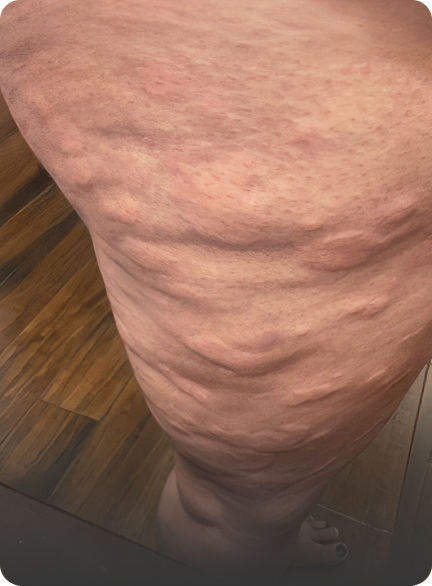
56 years old
“The itchy hives made me uncomfortable.”
—Thelma
Initial signs and symptoms
- Developed red hives all over her body at age 11
- Misdiagnosed as having a food allergy and was prescribed antihistamines, which provided temporary control, but symptoms recurred
- Continued to have flares of itch and hives for decades, despite multiple appointments and tests
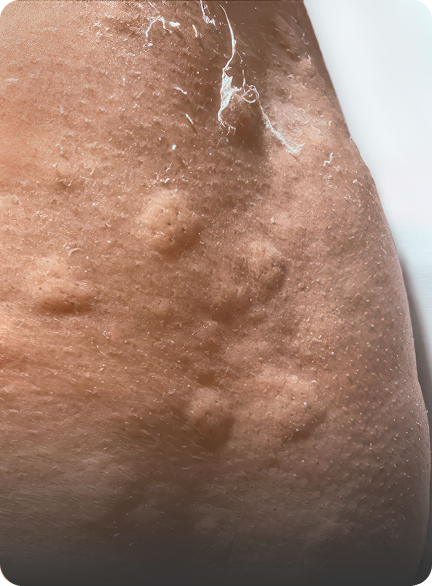
56 years old
“My itch made me limit my family gatherings.”
—Thelma
Coping with her condition, before diagnosis
- Treated with multiple antihistamines at varying doses, often taken multiple times per day
- Tried a variety of different topical emollients and moisturizers, but her symptoms were still uncontrolled
- Required frequent physician visits for recurring flares of itch and hives

59 years old
“With DUPIXENT, I'm going places with less itch and fewer hives.”
—Thelma
Finding hope
- Referred to a dermatologist who diagnosed CSU
- Discussed treatment options and decided to start DUPIXENT
- Trained by a nurse on how to inject, which made Thelma feel more at ease
- Noticed improvement some weeks after starting DUPIXENT, with less itch and fewer hives
- Has been taking DUPIXENT for 8 months, and it continues to work well for her
56 years old
“The itchy hives made me uncomfortable.”
—Thelma
Initial signs and symptoms
- Developed red hives all over her body at age 11
- Misdiagnosed as having a food allergy and was prescribed antihistamines, which provided temporary control, but symptoms recurred
- Continued to have flares of itch and hives for decades, despite multiple appointments and tests
56 years old
“My itch made me limit my family gatherings.”
—Thelma
Coping with her condition, before diagnosis
- Treated with multiple antihistamines at varying doses, often taken multiple times per day
- Tried a variety of different topical emollients and moisturizers, but her symptoms were still uncontrolled
- Required frequent physician visits for recurring flares of itch and hives
59 years old
“With DUPIXENT, I'm going places with less itch and fewer hives.”
—Thelma
Finding hope
- Referred to a dermatologist who diagnosed CSU
- Discussed treatment options and decided to start DUPIXENT
- Trained by a nurse on how to inject, which made Thelma feel more at ease
- Noticed improvement some weeks after starting DUPIXENT, with less itch and fewer hives
- Has been taking DUPIXENT for 8 months, and it continues to work well for her
Clinical Trial Designs and Results
Trial Designs: 284 adults and adolescents (aged 12+ years) with CSU who remained symptomatic despite H1 antihistamine treatment were randomized in CUPID-A and CUPID-C to DUPIXENT or placebo. All participants were anti-IgE treatment naive and remained on a stable H1 antihistamine dose. DUPIXENT-treated adults and adolescents ≥60 kg received 300 mg Q2W after a 600 mg loading dose, and adolescents 30 kg to <60 kg received 200 mg Q2W after a 400 mg loading dose.1,2
Trial Results: The primary endpoint in both trials was change from baseline in ISS7 at Week 24 (CUPID-A: 64% reduction with DUPIXENT vs 35% with placebo [10.44-point LSM reduction from a baseline mean of 16.25 vs 6.02-point reduction from a baseline mean of 15.74, respectively; P=0.0003]; CUPID-C: 48% reduction with DUPIXENT vs 33% with placebo [8.5-point LSM reduction from a baseline mean of 15.18 vs 6.13-point reduction from a baseline mean of 14.96, respectively; P=0.0270]). Other endpoints included change from baseline in HSS7 (secondary endpoint) at Week 24 (CUPID-A: 68% reduction with DUPIXENT vs 36% with placebo [10.54-point LSM reduction from a baseline mean of 15.85 vs 5.85-point reduction from a baseline mean of 15.03, respectively; P=0.0001]; CUPID-C: 46% reduction with DUPIXENT vs 31% with placebo [7.16-point LSM reduction from a baseline mean of 13.31 vs 5.15-point reduction from a baseline mean of 12.90, respectively; P=0.0450]); change from baseline in UAS7 (secondary endpoint) at Week 24 (CUPID-A: 66% reduction with DUPIXENT vs 36% with placebo [20.99-point LSM reduction from a baseline mean of 32.10 vs 11.95-point reduction from a baseline mean of 30.76, respectively; P=0.0001]; CUPID-C: 48% reduction with DUPIXENT vs 32% with placebo [15.61-point LSM reduction from a baseline mean of 28.48 vs 11.27-point reduction from a baseline mean of 27.86, respectively; P=0.0324]); the proportion of patients with well-controlled symptoms (UAS7≤6, secondary endpoint) at Week 24 (CUPID-A: 47% of patients treated with DUPIXENT vs 24% with placebo [P=0.0034]; CUPID-C: 40% vs 23%, respectively [P=0.0062]); and the proportion of participants who were urticaria-free (UAS7=0, secondary endpoint) at Week 24 (CUPID-A: 32% of patients treated with DUPIXENT vs 13% with placebo [P=0.0133]; CUPID-C: 30% vs 17%, respectively [P=0.0165]).1,2
THAN
aThe worldwide patient number is largely comprised of patients treated with DUPIXENT from 11 countries (Brazil, Canada, China, France, Germany, Italy, Japan, the Netherlands, Spain, UK, and US) and the rest of the world comprising ≈12% of this worldwide patient number. This number is composed of the following US-approved indications: AD, AFRS, asthma, BP, COPD, CRSwNP, CSU, PN, and EoE. Data through March 2026.
Get patient access support
AD, atopic dermatitis; AFRS, allergic fungal rhinosinusitis; BP, bullous pemphigoid; COPD, chronic obstructive pulmonary disease; CRSwNP, chronic rhinosinusitis with nasal polyps; CSU, chronic spontaneous urticaria; EoE, eosinophilic esophagitis; HSS7, hives severity score over 7 days; ISS7, itch severity score over 7 days; LSM, least squares mean; PN, prurigo nodularis; Q2W, once every 2 weeks; UAS7, urticaria activity score over 7 days.