)
endpoints with DUPIXENT
vs Xolair® (omalizumab): NPS, UPSIT score,
NC score, and LoS score improvement at Week 24.1

EVEREST HEAD-TO-
HEAD STUDY DESIGN1
EVEREST was a randomized, double-blind, parallel-group, active-controlled, multicenter phase 4 study designed to assess
the comparative efficacy and safety of
DUPIXENT vs Xolair over 24 weeks of treatment in 360 adult patients with uncontrolled
severe CRSwNP and coexisting asthma. Patients were required to have
bilateral nasal polyps (NPS ≥5) with symptoms of
nasal congestion and loss of smell for at least 8 weeks before screening and physician-diagnosed asthma for
≥12 months
that is uncontrolled with controller medications.
The coprimary endpoints were change from baseline at Week 24 in NPS and UPSIT score. Key secondary endpoints
were change from baseline at Week 24 in
daily LoS score and NC score. Other secondary endpoints included change from
baseline at Week 24 in SNOT-22 score. Other endpoints included change from
baseline at Week 24 in lung function (eg,
pre-bronchodilator FEV1). Safety was also assessed.
N=360
run-in period
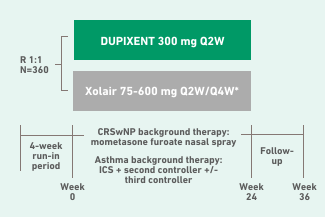
*75 to 600 mg SC Q2W or Q4W according to weight tier and IgE levels.
Study limitations include the relatively short treatment duration, which might not have given treatment effects time to
plateau, and the
absence of efficacy assessments at the end of the 12-week follow-up. Evidence from longer-term studies of
dupilumab and omalizumab suggest that their
treatment effects continue to increase beyond 24 weeks. Small sample sizes in
some prespecified subgroups mean that conclusions cannot be drawn about the
influence of some characteristics on
treatment effects. The low numbers of patients who had severe asthma exacerbations or endoscopic sinus surgery in both
groups made median times to these events difficult to calculate, and would require larger comparative studies. Further
studies will be necessary to identify subgroups of patients with CRSwNP by phenotype who might respond better to
omalizumab
than to dupilumab.
FEV1, forced expiratory volume in 1 second; ICS, inhaled corticosteroids; Q2W, once every 2 weeks; Q4W, once every 4 weeks; R, randomized; SC, subcutaneously; SNOT-22, 22-item Sino-Nasal Outcome Test.
SUPERIORITY WITH DUPIXENT IN POLYP BURDEN AND SENSE OF SMELL IMPROVEMENT VS XOLAIR AT WEEK 241
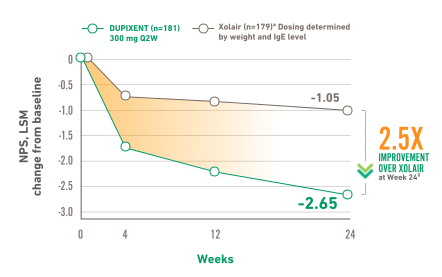
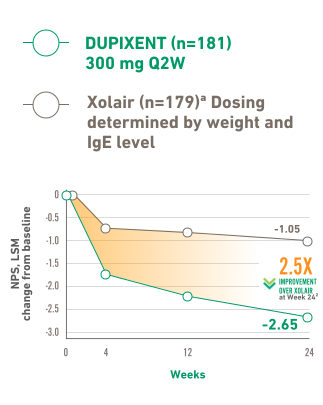
Analysis was not multiplicity controlled prior to Week 24. Results are descriptive. Definitive conclusions cannot be made.
- NPS at Week 24 in EVEREST (coprimary endpoint). LSM difference between DUPIXENT 300 mg Q2W + SOC
(n=181) and Xolair + SOC (n=179): -1.60 (95% CI: -1.96,
-1.25) (P <0.0001)1
NPS, the sum of right and left nostril scores (range 0-4 for each
nostril, range 0-8 in total) as evaluated by nasal endoscopy:
reduced score indicates improvement.1
a75 to 600 mg SC Q2W or Q4W according to weight tier and IgE levels.1
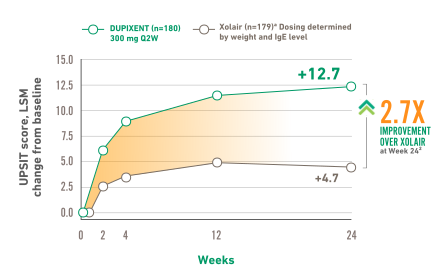
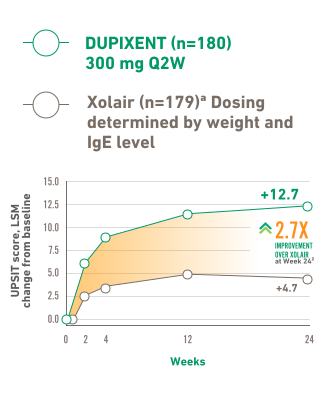
Analysis was not multiplicity controlled prior to Week 24. Results are descriptive. Definitive conclusions cannot be made.
- At Week 24 in EVEREST (coprimary endpoint),
improvements in UPSIT score were significantly greater
with DUPIXENT 300 mg Q2W + SOC (n=181) vs Xolair +
SOC (n=179). Analysis in the ITT population: LSM
difference: 8.0 (95% CI: 6.3, 9.7) (P<0.0001)1
UPSIT score (range 0-40): higher score indicates improvement.1
a75 to 600 mg SC Q2W or Q4W according to weight tier and IgE levels.1
SUPERIOR IMPROVEMENT
ACROSS KEY SECONDARY
ENDPOINTS1

NASAL CONGESTION
IMPROVEMENT
in NC score with DUPIXENT
(n=181) at Week 24 vs -1.05
with Xolair (n=179);
LSM difference: -0.58 (95%
CI: -0.74, -0.42) (P<0.0001)1

LOSS OF SMELL
IMPROVEMENT
in LoS score with DUPIXENT
(n=181) at Week 24 vs -0.74
with Xolair (n=179);
LSM difference: -0.81 (95% CI:
-1.01, -0.61) (P<0.0001)1
RESULTS IN
OTHER SECONDARY
ENDPOINT1

QUALITY OF LIFE
IMPROVEMENT
in SNOT-22 score with DUPIXENT
(n=181)at Week 24 vs -31.9
with Xolair (n=179);
LSM difference: -12.7
(95% CI: -16.7, -8.8)1
SNOT-22 endpoint was not in the
statistical hierarchy and was not
included in multiplicity adjustments.
Results are descriptive. Definitive
conclusions cannot be made.1
NC score (range 0-3): reduced score indicates improvement.1
LoS score (range 0-3): reduced score indicates improvement.1
SNOT-22 score (range 0-110): reduced score indicates improvement.1
ITT, intention-to-treat; LSM, least squares mean; Q2W, once every 2 weeks; Q4W, once every 4 weeks; SC, subcutaneously; SNOT-22, 22-item Sino-Nasal
Outcome Test; SOC, standard of care.
IMPROVEMENT IN LUNG FUNCTION FOR CRSwNP PATIENTS WITH COEXISTING ASTHMA1
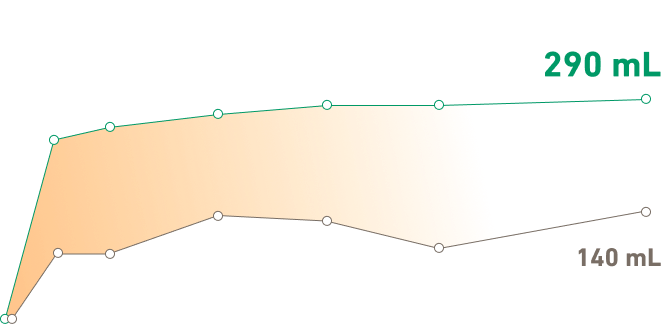
FEV1 endpoint was not in the statistical hierarchy and was not included in multiplicity adjustments.
Results are descriptive. Definitive conclusions cannot be made.
According to the DUPIXENT Prescribing Information, in subjects with CRSwNP and coexisting asthma, improvements in pre-bronchodilator FEV1 were similar to those of subjects in the DUPIXENT asthma program.
DUPIXENT is indicated as an add-on maintenance treatment of adult and pediatric patients aged 6 years and older with moderate-to-severe asthma characterized by an eosinophilic phenotype or with oral corticosteroid dependent asthma. Limitations of Use: DUPIXENT is not indicated for the relief of acute bronchospasm or status asthmaticus.
- bPre-bronchodilator FEV1 at Week 24 in EVEREST (other endpoint). Analysis in the ITT population: LSM difference between DUPIXENT 300 mg Q2W + SOC (n=181) and Xolair + SOC (n=179): 150 mL (95% CI: 50, 260).1
- c75 to 600 mg SC Q2W or Q4W according to weight tier and IgE levels.1
- FEV1, forced expiratory volume in 1 second; ITT, intention-to-treat; LSM, least squares mean; Q2W, once every 2 weeks; Q4W, once every 4 weeks; SC, subcutaneously; SOC, standard of care.
SAFETY RESULTS WERE CONSISTENT WITH THE KNOWN SAFETY PROFILES OF DUPIXENT AND XOLAIR1
Safety profiles of DUPIXENT and Xolair were generally similar in the EVEREST trial1
| Treatment-emergent adverse events occurring in ≥5% of patients, n (%)d,e | DUPIXENT (n=179), n (%) |
Xolair (n=173), n (%) |
|---|---|---|
| Nasopharyngitis | DUPIXENT (n=179), n (%)21 (12) |
Xolair (n=173), n (%)20 (12) |
| Accidental overdose | DUPIXENT (n=179), n (%)12 (7) |
Xolair (n=173), n (%)21 (12) |
| Headache | DUPIXENT (n=179), n (%)10 (6) |
Xolair (n=173), n (%)13 (8) |
| Upper respiratory tract infection | DUPIXENT (n=179), n (%)10 (6) |
Xolair (n=173), n (%)8 (5) |
| Cough | DUPIXENT (n=179), n (%)9 (5) |
Xolair (n=173), n (%)2 (1) |
In the safety population, which included all patients who were randomized and received at least one dose of study medication, the number of patients with any TEAE was similar in the DUPIXENT and Xolair groups: 64% (115/179) vs 67% (116/173) of patients, respectively. Two percent (3/179) of patients in the DUPIXENT group and 4% (7/173) of patients in the Xolair group had serious TEAEs, and there were no TEAEs leading to death. TEAEs leading to permanent study discontinuation occurred in 3% (5/179) and 1% (2/173) of patients in the DUPIXENT and Xolair groups, respectively.
dSafety population; following randomization, 2 patients in the DUPIXENT group and 6 in the Xolair group did not receive treatment and were therefore not included in the safety population.
eAccording to the preferred terms of the Medical Dictionary for Regulatory Activities (MedDRA).
TEAE, treatment-emergent adverse event.
CRSwNP, chronic rhinosinusitis with nasal polyps; LoS, Loss of Smell; NC, nasal congestion; NPS, nasal polyp score; UPSIT, University of Pennsylvania Smell Identification Test.