)
Do You Have Copd Patients with the Following Characteristics?
Inadequately controlled
while receiving triple
inhaled therapy1:
With symptoms like
breathlessness, cough,
mucus,
and dyspnea
Triple therapy consisted of LAMA+LABA+ICS.
At risk for exacerbations1:
Experienced moderate or severe
exacerbations in
previous year
Elevated blood EOS as
evidence of type 2
inflammation1

Patient profiles are representative
and not actual DUPIXENT patients.
Rita’s clinical profile and challenges
- Experienced 2 exacerbations in the last 12 months requiring OCS prescribed by her PCP
- Compliant with triple inhaled therapy (LAMA + LABA + ICS)
- Coughing and fatigue are affecting her work
- EOS count performed by her pulmonary specialist after most recent appointment:
200 cells/μL- This prompted the pulmonary specialist to review her EHR and found
EOS=400 cells/μL in the past 12 months*
- This prompted the pulmonary specialist to review her EHR and found
Explore DUPIXENT data
for a patient like Rita
Up to 34% Reduction in Exacerbations1-3
(PRIMARY ENDPOINT)BOREAS Trial30% reduction in the annualized rate of moderate or severe exacerbationsa for DUPIXENT + triple therapy (0.78 exacerbations per year [n=468] vs 1.10 for placebo + triple therapy [n=471]; P<0.001)b
NOTUS Trial34% reduction in the annualized rate of moderate or severe exacerbationsa for DUPIXENT + triple therapy (0.86 exacerbations per year [n=470] vs 1.30 for placebo + triple therapy [n=465]; P<0.001)c
51% of patients reported a clinically meaningful improvement in quality of live scores1-4,*
*as measured by SGRQ
(PRIMARY ENDPOINT)BOREAS Trial51% of patients reported a clinically meaningful (≥4-point) improvement in SGRQ scores at Week 52 with DUPIXENT + triple therapy vs 43% for placebo + triple therapy (N=939; OR: 1.44; 95% CI: 1.10, 1.89; P=0.009)1,2,d
NOTUS Trial51% responder rate at Week 52 for subjects treated with DUPIXENT + triple therapy vs 47% for placebo + triple therapy (N=721; OR: 1.16; 95% CI: 0.86, 1.58)1,3
NOTUS results are descriptive. Definitive conclusions cannot be made.
Patients showed improvement in lung function through week 521,e
Change in post-bronchodilator FEV1 from baseline at Week 12 and Week 52 (ITT population; secondary endpoint)1
BOREAS Trial138 mL numerical improvement for DUPIXENT + triple therapy (n=468) vs 58 mL for placebo + triple therapy
(n=471) at Week
521
127 mL numerical improvement for DUPIXENT + triple therapy (n=362) vs 59 mL for placebo + triple therapy (n=359) at Week 52 (LSM change from baseline, ITT population)1,5
Post-bronchodilator lung function results are descriptive. Definitive conclusions cannot be made.
Significant improvements of similar magnitude were observed in change from baseline in pre-bronchodilator FEV1 at Weeks 12 and 52 in subjects treated with DUPIXENT compared to placebo across the BOREAS and NOTUS trials.
DUPIXENT is the only biologic in COPD that delivered efficacy across all three measures: exacerbation
reduction, lung function improvement, and quality of life improvement1-3
*Rita’s baseline eosinophil count has fluctuated, which is expected as eosinophil levels fluctuate significantly, even hour to hour. 40% of patients in DUPIXENT trials had EOS <300 at randomization, but all patients had EOS ≥300 at screening. Regardless of eosinophil levels at baseline, DUPIXENT reduced patients’ annualized rate of moderate or severe exacerbations. Patients’ eosinophil levels should be checked and results from previous years reviewed for history of elevated eosinophils, as eosinophil levels fluctuate.6-8
aModerate exacerbations were defined as exacerbations that resulted in treatment with a systemic glucocorticoid, an antibiotic agent, or both. Severe exacerbations were defined as exacerbations that led to hospitalization or an emergency medical care visit or that resulted in death.1-3
bRate ratio vs placebo: 0.71 (95% CI: 0.58, 0.86).1
cRate ratio vs placebo: 0.66 (95% CI: 0.54, 0.82).1
dThe SGRQ is a 50-item questionnaire designed to measure and quantify health status in adult patients with chronic airflow limitation. Higher score indicates greater disease severity.4
eIn the NOTUS trial, patients administered DUPIXENT + triple therapy saw nominal improvement in post-bronchodilator FEV1 of 134 mL at Week 12 and 127 mL at Week 52 (n=362), compared with 67 mL at Week 12 (n=465) and 59 mL at Week 52 (n=359) in patients receiving placebo + triple therapy (LSM change from baseline, ITT population).1,5
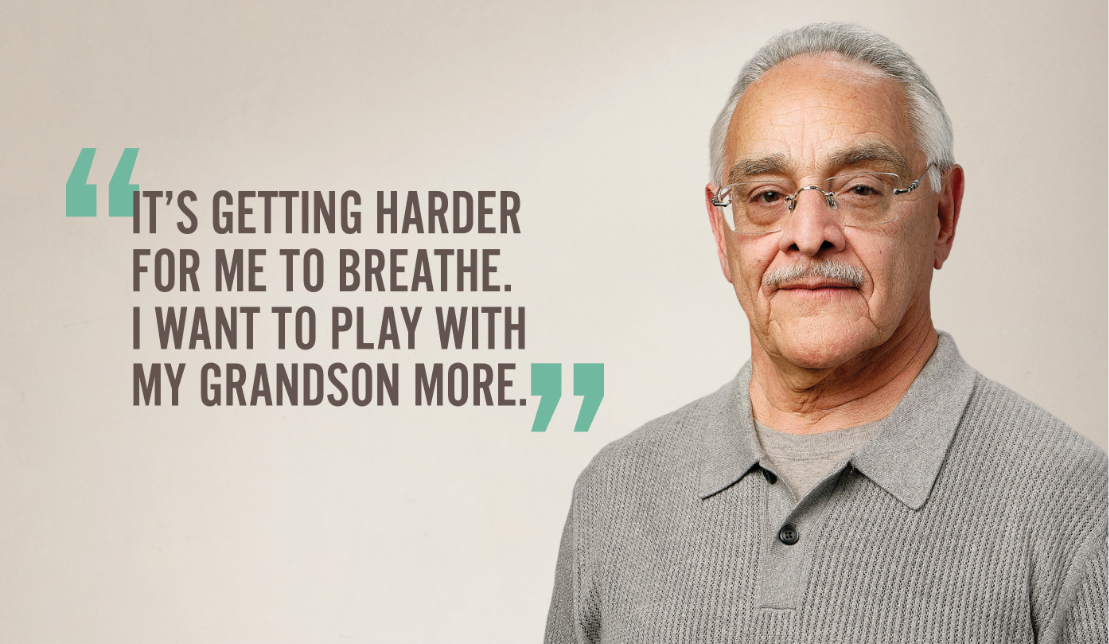
Patient profiles are representative
and not actual DUPIXENT patients.
Felix’s clinical profile and challenges
- Dyspnea can get in the way of his daily activities
- History of hypertension, depression, and sleep apnea
- Experienced a severe COPD exacerbation in the previous 12 months
- Compliant with triple inhaled therapy (LAMA + LABA + ICS)
- Elevated blood EOS level, a marker of type 2 inflammation
Explore DUPIXENT data
for a patient like Felix
Up to 34% Reduction in Exacerbations1-3
(PRIMARY ENDPOINT)BOREAS Trial
30% reduction in the annualized rate of moderate or severe exacerbationsa for DUPIXENT + triple therapy (0.78 exacerbations per year [n=468] vs 1.10 for placebo + triple therapy [n=471]; P<0.001)b
NOTUS Trial34% reduction in the annualized rate of moderate or severe exacerbationsa for DUPIXENT + triple therapy (0.86 exacerbations per year [n=470] vs 1.30 for placebo + triple therapy [n=465]; P<0.001)c
Patients showed improvement in lung function through week 521,d
Change in post-bronchodilator FEV1 from baseline at Week 12 and Week 52 (ITT population; secondary endpoint)1
BOREAS Trial138 mL numerical improvement for DUPIXENT + triple therapy (n=468) vs 58 mL for placebo + triple therapy (n=471) at Week 521
NOTUS Trial127 mL numerical improvement for DUPIXENT + triple therapy (n=362) vs 59 mL for placebo + triple therapy (n=359) at Week 52 (LSM change from baseline, ITT population)1,5
Post-bronchodilator lung function results are descriptive. Definitive conclusions cannot be made.
Significant improvements of similar magnitude were observed in change from baseline in pre-bronchodilator FEV1 at Weeks 12 and 52 in subjects treated with DUPIXENT compared to placebo across the BOREAS and NOTUS trials.
Based on a post hoc pooled analysis of BOREAS and NOTUS,
COPD EXACERBATIONS LEADING TO HOSPITAL VISITSe REDUCED BY 38%9
In patients on DUPIXENT + triple therapy vs placebo + triple therapy, 0.16 for placebo (0.12-0.22) vs 0.10 for DUPIXENT (0.07-0.14)
(N=1874; OR: 0.621; 95% Cl; 0.427 .901) adjusted annualized rate of exacerbations leading to hospital visits9,f
Results are descriptive. Definitive conclusions cannot be made.
aModerate exacerbations were defined as exacerbations that resulted in treatment with a systemic glucocorticoid, an antibiotic agent, or both. Severe exacerbations were defined as exacerbations that led to hospitalization or an emergency medical care visit or that resulted in death.1-3
bRate ratio vs placebo: 0.71 (95% CI: 0.58-0.86).1
cRate ratio vs placebo: 0.66 (95% CI: 0.54, 0.82).1
dIn the NOTUS trial, patients administered DUPIXENT + triple therapy saw nominal improvement in post-bronchodilator FEV1 of 134 mL at Week 12 and 127 mL at Week 52 (n=362), compared with 67 mL at Week 12 (n=465) and 59 mL at Week 52 (n=359) in patients receiving placebo + triple therapy (LSM change from baseline, ITT population).1,5
eHospital visits is hospitalization or emergency department visits of any duration.9
fBased on a post hoc analysis of BOREAS and NOTUS; phase 3, randomized, double-blind, placebo-controlled trials. Adjusted annualized rate of severe exacerbations and/or ED visits of patients ages 40 to 85 years with COPD, moderate-to-severe airflow limitation, and type 2 inflammation (screening blood eosinophils ≥300 cells/µL) on LABA/LAMA/ICS. Patients received add-on dupilumab 300 mg or matching placebo Q2W for up to 52 weeks. Severe exacerbations and/or ED visits defined as exacerbations requiring hospitalization or an emergency department visit of any duration.9
DUPIXENT DELIVERED MORE OF THE THINGS THAT MATTER TO PATIENTS WITH COPD1
BETTER
BREATHING*
QUALITY OF LIFE
IMPROVEMENT
EXACERBATION REDUCTIONS
As defined by change from baseline in FEV1 at Weeks 12 and 52. FEV1, forced expiratory volume in 1 second.
COPD, chronic obstructive pulmonary disease; ED, emergency department; EHR, electronic health record; EOS, eosinophils; FEV1,
forced
expiratory volume in 1 second; ICS, inhaled corticosteroid; ITT, intention-to-treat; LABA, long-acting beta agonist; LAMA, long-
acting muscarinic antagonist; LSM,
least squares mean; OCS, oral corticosteroids; OR, odds ratio; PCP, primary care physician; Q2W,
once every 2 weeks; SGRQ, St George’s Respiratory
Questionnaire.
Help appropriate patients with the first and only dual inhibitor of IL-4 and IL-13 signaling—two of the key drivers of type 2 inflammation1,f
fThe mechanism of dupilumab action has not been definitively established.1
Get more information on the
clinical trials
Explore the full study designs
FREQUENTLY ASKED QUESTIONS
DUPIXENT is indicated as an add-on maintenance treatment in adult patients with inadequately controlled chronic obstructive pulmonary disease (COPD) and an eosinophilic phenotype.1
Limitations of Use: DUPIXENT is not indicated for the relief of acute bronchospasm.1
Patients enrolled in the BOREAS and NOTUS trials were required to have the following baseline characteristics1-3:
- Current or former tobacco smokers who had a smoking history of at least 10 pack-years
- Aged 40 to 85 years at time of screeningg
- Had physician-diagnosed COPD for at least 12 months
- Had a post-bronchodilator ratio of the forced expiratory volume in 1 second (FEV1) to the forced vital capacity of less than 0.70 and a post-bronchodilator FEV1 of 30% to 70% of the predicted normal value
- Received a dyspnea score of grade 2 or higher on the Medical Research Council dyspnea scale (scores range from 1 to 5, with higher scores indicating more severe dyspnea)
- Were receiving background triple inhaler therapy (LAMA+LABA+ICS) for at least 3 months and a stable dose of this therapy for at least 1 monthi
- Displayed signs or symptoms of chronic bronchitis for at least 3 months during the year before screening
- Had an absolute blood eosinophil count of at least 300 cells/μL at the screening visit
- Experienced at least two moderate exacerbations or at least one severe exacerbation within the previous year; at least one of the moderate exacerbations must have resulted in the use of systemic glucocorticoids; and at least one exacerbation must have occurred while the patient was receiving triple inhaled therapyh
- Had no history of asthma
gBOREAS Trial aged 40 to 80 years at time of screening.
hOr double inhaled therapy (LAMA+LABA) if an ICS was contraindicated.
COPD, chronic obstructive pulmonary disease; ICS, inhaled corticosteroid; LABA, long-acting beta agonist; LAMA, long-acting muscarinic antagonist.
study designs