DUPIXENT TARGETS TWO OF THE KEY DRIVERS OF TYPE 2 INFLAMMATION—
IL-4 AND IL-13
SIGNALING1-3,*
DUPIXENT inhibits IL-4 and IL-13 signaling by specifically binding to the IL-4 receptor alpha (IL-4Rα) subunit.1,* Blocking IL-4Rα with DUPIXENT inhibits IL-4– and IL-13–induced inflammatory responses, including mucosal IgE production, and lowers total IgE in the blood of patients with CRSwNP, thereby demonstrating both local and systemic effects of DUPIXENT on these markers of type 2 inflammation in CRSwNP1,4,*:
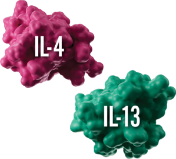
DUPIXENT targets THE SIGNALING OF both the IL-4 and
IL-13 cytokines,
meaning we are targeting these
two major drivers
of type 2 inflammation common
to CRSwNP.1-3,*
Nicole Chase, MD, FAAP, FAAAAI, FACAAI
Allergist/Immunologist, Partner, St. Paul Allergy & Asthma, P.A.
Associate Professor, University of Minnesota School of Medicine
LOCAL
INFLAMMATION
Physiological features1-3
- Mucus hypersecretion
- Epithelial barrier dysfunction
Associated clinical features
- Impaired olfactory function5
- Tissue remodeling6
- Polyp growth and recurrence7,8
SYSTEMIC
INFLAMMATION1-3
- Elevated IgE levels
- Elevated eosinophil levels
*The mechanism of dupilumab action has not been definitively established.1
DUPIXENT IS THE FIRST AND ONLY FDA-APPROVED DUAL
INHIBITOR OF IL-4 AND IL-13 SIGNALING1,*
The IL-4 and IL-13 cytokines induce inflammatory responses and cell signaling, contributing to1-3:
B-cell class switching and production of IgE
Mast cell activation
Epithelial barrier dysfunction, goblet cell hyperplasia, and mucus hypersecretion
Eosinophil activation and trafficking into tissues
Frequently Asked Questions About CRSwNP
DUPIXENT is the first and only dual inhibitor of IL-4 and IL-13 signaling, addressing type 2 inflammation that contributes to CRSwNP.1-3,* DUPIXENT is not a steroid.1 DUPIXENT inhibits IL-4 and IL-13 cytokine-induced inflammatory responses and cell signaling.1-3,* These cytokines contribute to IgE production, mast cell activation, eosinophil activation and trafficking, epithelial barrier dysfunction, and Th2 cell activation.1-3
*The mechanism of dupilumab action has not been definitively established.1
Up to 87% of CRSwNP patients have evidence of type 2 inflammation.9
CRSwNP, chronic rhinosinusitis with nasal polyps.
Eligible CRSwNP Patients