Participants (N=106) were randomized to DUPIXENT or placebo and began taking oral corticosteroids (OCS) on Day 1, followed by a protocol-defined taper1-3
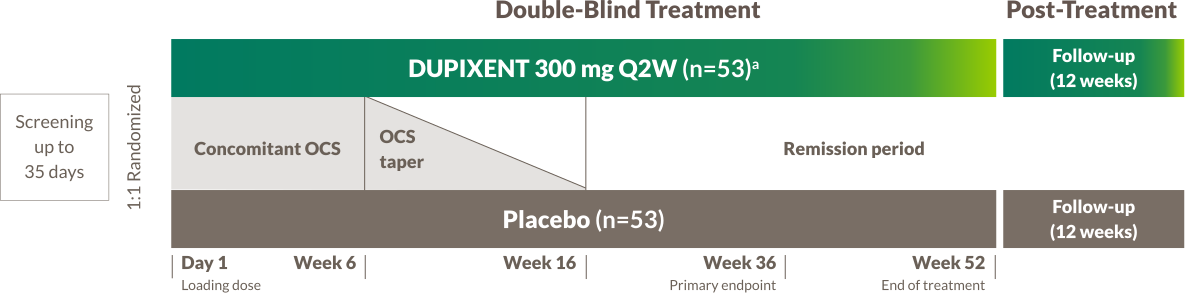
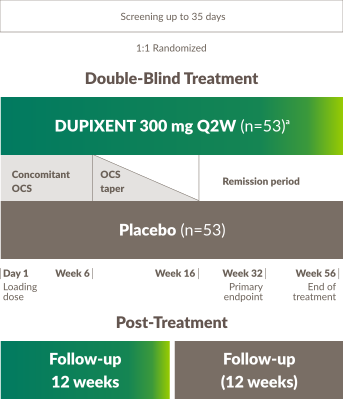
aParticipants received a loading dose of 600 mg (2 x 300 mg SC injections) on Day 1.
Screening period + OCS dosing
- During the screening period, OCS and medium- to high-potency TCS (and any other treatments being taken for bullous pemphigoid) were washed out ≥7 days prior to starting randomized therapy3
- 63% of participants had prior systemic corticosteroid use for bullous pemphigoid1
- On Day 1, all participants started a standard-of-care regimen of prednisone or prednisolone, 0.5 or 0.75 mg/kg/day1
OCS taper
- OCS taper was to begin no later than Week 61-3
- Taper began after 2 weeks of maintained disease control, defined as no new lesions and existing lesions beginning to heal
- Taper had to be completed by Week 16 to meet the primary endpoint
Primary endpoint—proportion of patients achieving sustained
remission at Week 361,2
THE PRIMARY ENDPOINT CONSISTED OF 3 COMPONENTS
and Off OCS
by Week 16
from baseline
to Week 36 and
after completing OCS taper
to Week 36
aComplete remission defined as the absence of new lesions and epithelialization of old lesions. During OCS taper, participants were permitted to increase their OCS dose once (subsequent dose increases were considered rescue therapy).1,2
bRescue therapy could include a second increase of OCS dose during the taper period, use of OCS after completion of the OCS taper/Week 16, or initiation of high-potency TCS, systemic nonsteroidal immunosuppressive medication, or immunomodulating biologic therapy.1,2
cDisease relapse defined as appearance of ≥3 new lesions/month (blisters, eczematous lesions, or urticarial plaques) or ≥1 large (>10 cm in diameter) eczematous lesion or urticarial plaque that did not heal within 1 week.1,2
Secondary endpoints at Week 36 included1,2:
- Proportion of subjects with a ≥4-point reduction in Peak Pruritus NRS
- Total cumulative dose of OCS
DUPIXENT was studied in an elderly patient population1-3
Select inclusion criteriaa
- ≥18 to 90 years of age
- Peak Pruritus NRS ≥4 (on a scale of 0 to 10)
- BPDAI activity score ≥24 (on a scale of 0 to 360)
Baseline demographics (mean)
- 71 years of age
- Peak Pruritus NRS of 7.5
- Moderate or severe disease (as measured by BPDAI activity score)
- 66% of participants had moderate disease (score of ≥24 to <60)
- 34% of participants had severe disease (score of ≥60)
aNot comprehensive of all inclusion criteria.
Explore DUPIXENT data in bullous pemphigoid
BPDAI, Bullous Pemphigoid Disease Area Index; NRS, numerical rating scale; Q2W, once every 2 weeks; SC, subcutaneous; TCS, topical corticosteroids.